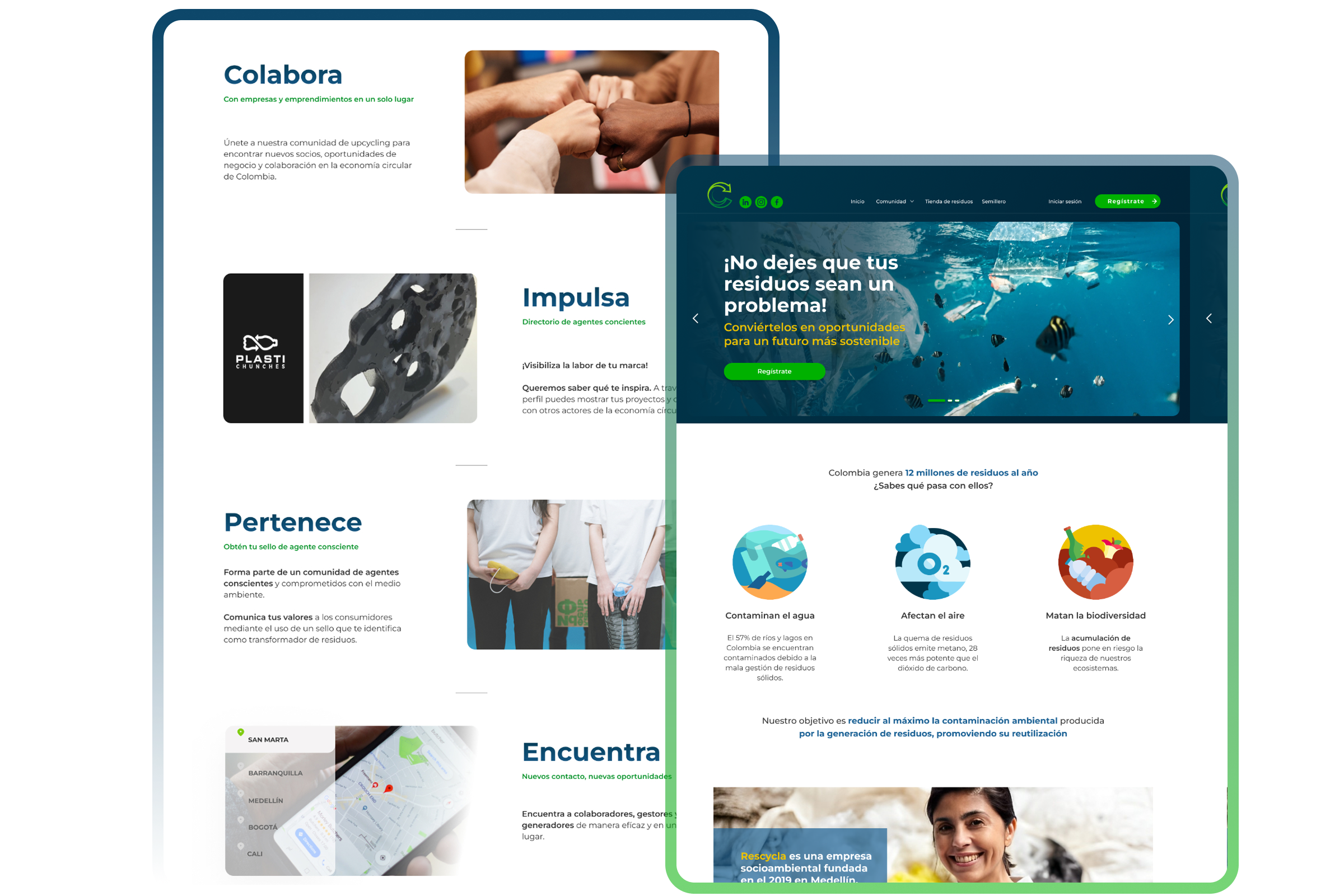
Colombian upcycling platform connecting waste generators with those who can transform their materials. I redesigned the landing page and key pages to communicate the value of the circular economy and invite the community to join.
The partnership between PALM and Rescycle represents an innovative response to the escalating waste crisis. Leveraging a cutting-edge technological platform, this collaboration connects waste generators with those capable of effectively repurposing materials.
Focused on the principles of the circular economy, the initiative aims to transform waste into valuable resources, significantly reducing landfill and open dump waste. As the UX Design team, we are excited to join PALM and Rescycle in their mission to build a cleaner, more sustainable future for all.
The Process: Design Thinking
01
Empathize
02
Define
03
Ideate
04
Design
05
Test
The Challenge
1
Design a section on the public website targeted at waste recyclers, detailing the plans, registration process, and terms and conditions.
2
Design the homepage to communicate the platform's concept and invite both waste recyclers and generators to join the community (call to action).
palm-challenge.png
Good to the planet
Designed to Disappear.
Problem Statement
The problem
Rescycle currently has a published platform but lacks a clear identity in terms of user experience (UX). Despite a significant supply of waste materials, there exists a disparity between supply and demand, indicating challenges in attracting users who can utilize the advertised waste materials.
Intentions
Understanding User Profiles in Circular Economy Platforms: analyzing user personas within circular economy platforms to tailor the UX design for upcycling product creation.
Understanding User Expectations and Anticipated Benefits: employing user research methodologies to grasp user expectations, thus informing UX decisions aimed at meeting user needs effectively.
Identifying Pain Points During Sign-Up: conducting user journey mapping to uncover friction points and user needs during the registration process on Rescycle or analogous waste offering platforms.
Goals
Effectively communicate the importance and power of the Circular Economy in Colombia.
To increase demand, we aim to onboard 40 new Upcycling companies onto the platform within the next 4 months.
Open the door to building community with a human and close voice tone.
How did we get to know our users?
Final users: large companies, startups, or collectives seeking to leverage online waste utilization for creating upcycled and downcycled products that are already users of our platform or have the potential to be one of them.
5
Moderated tests and user interviews with platforms and upcycling companies in Colombia
24
Individuals surveyed from the upcycling industry
10
Upcycling companies in worldwide UX/UI benchmarking
7
Guerrilla tests
3
Usability tests after mid-fidelity wireframes
+
Complementary desktop research
What We Found — Our Users
What they Think & Feel
"Technology should serve the environment, not the other way around." — Plastichunches.
"Creating a community around people who share your values and principles gives meaning to your work." — Akasha Design Lab.
"It's important to find spaces where they can showcase their venture with other entrepreneurs who share their vision." — Bolloplaya.
"For the startup it is vital supporting recyclers and offering a fair price." — Boyoplaya.
What they Do & Say
They have a multidisciplinary team that operates from various perspectives to develop a sustainable business model that is committed to social issues.
Their team members are passionate about their work and share their knowledge with their communities and on social media platforms.
They collaborate with other entrepreneurs, conduct recycling awareness talks in schools, and organize waste receptions with their neighbors.
What they Hear & See
They view waste as an opportunity to minimize environmental impact and generate income while prioritizing social responsibility.
Despite the numerous players in the recycling system, there is limited communication among them, which adds complexity to waste management.
Waste prices can vary greatly, ranging from free to high prices.
Key Findings
Find
Find materials that meet the technical needs in nearby locations for their upcycling startups.
Create Alliances
Establish links between agents that share environmental and social values genuinely and responsibly.
Plan Effectively
Generate long-term sustainable relationships to improve their business planning.
Awareness
Promote their brand, products, accomplishments, and influence.
Pain Points
Inconsistency
Logistics for transporting waste must be negotiated with each distributor, which is time-consuming and makes planning difficult, as there is no regulation.
Fluctuation
The prices for these transactions are not regulated, resulting in variations and an informal market.
Low Standards
The material waste obtained is not sorted or cleaned, which consumes time and resources.
Unreliable Information
The materials acquired often have inadequate labeling, and there is no technical data sheet to support the information provided for each purchase.
Insights
UpCycling companies aim to educate waste generators and build a community of like-minded businesses, while fulfilling their environmental and business commitments.
→ Landing Page
The proper management of waste information enhances user trust and reinforces a positive image of the platform.
→ Upcyclers Community
Ideation — UX Design Proposals
Based on the research data, we create proposals for MVPs that aim to solve our users' pain points.
1
Community Building through Storytelling
Employ storytelling design elements to foster a sense of community among users, emphasizing shared values.
2
Emphasize Strategic Partnerships
Highlight strategic alliances that bolster trust within the community, reinforcing the platform's credibility and fostering collaboration towards sustainable waste management initiatives.
3
Users Directory and Brand Visibility
Establish a company directory within the platform, offering a dedicated public space/profile for participating companies.
4
Streamlined Search and Tailored Suggestions
Efficiently find waste suppliers that match your requirements and location through search functionalities and personalized suggestions.
5
Validation of Sustainability Practices
Ensure sustainable production practices by verifying and providing documentation supporting waste management procedures.
6
Comprehensive Technical Data Sheets
Access detailed technical data sheets for waste products available in the marketplace to aid informed decision-making.
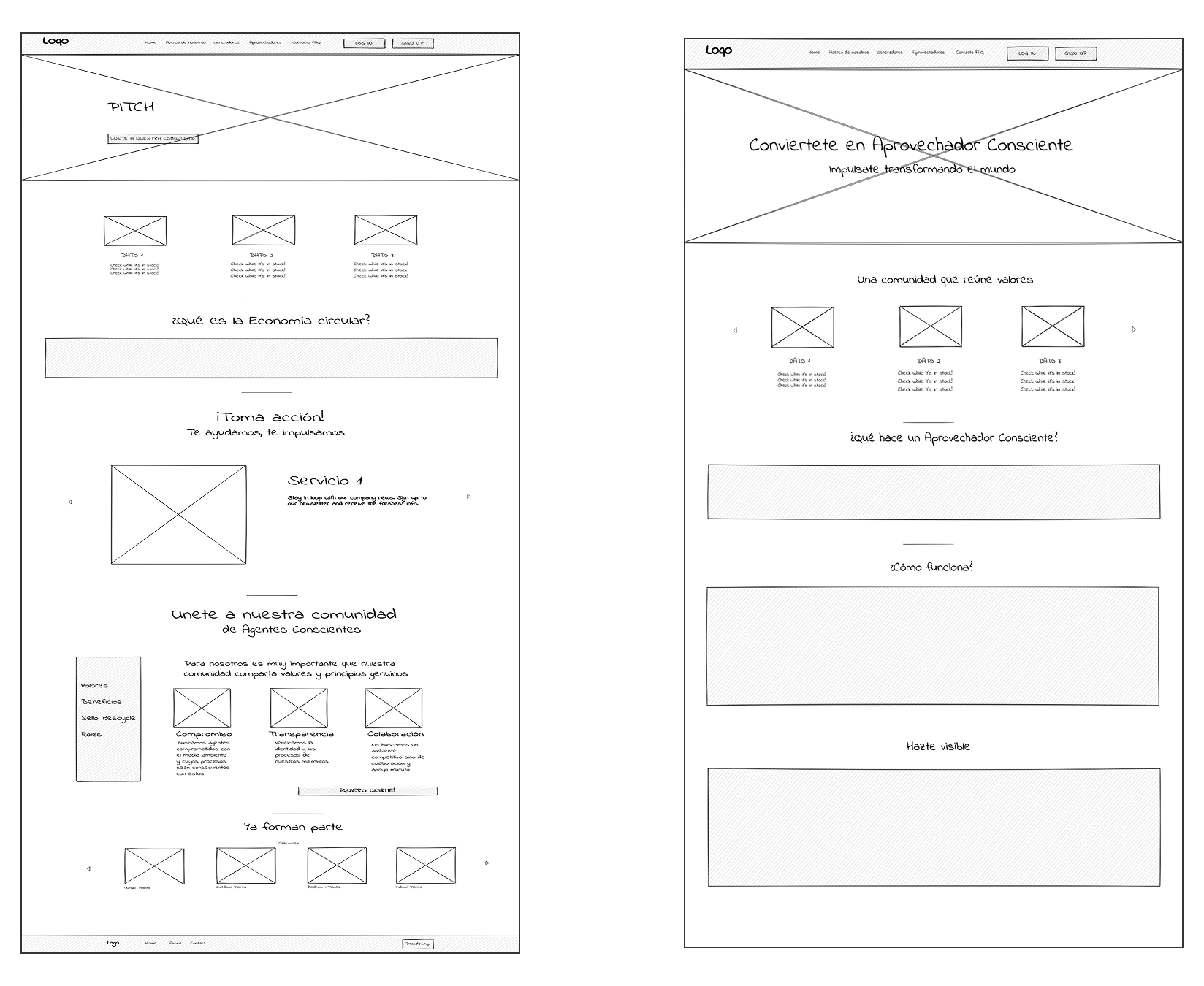
Low-Fidelity Wireframes
palm-wireframes.png
Low-fidelity wireframes — Landing page and Upcyclers Community
Design — Design System
Typography — Montserrat
Main Title — Montserrat 64 Bold
Section Title — Montserrat 40 Bold
Subtitle — Montserrat 32 Bold
Content 1 — Montserrat 24 Semibold
Content 2 — Montserrat 20 Regular
Button — Montserrat 18 Bold
Primary Colors
#3E8635
#57B22E
#123A5A
#2E5F8A
Secondary Colors
#4A9CC4
#E3C13F
#123A5A
#57B22E
Neutral Colors
#2D2D2D
#6E6E6E
#E8E8E8
#FFFFFF
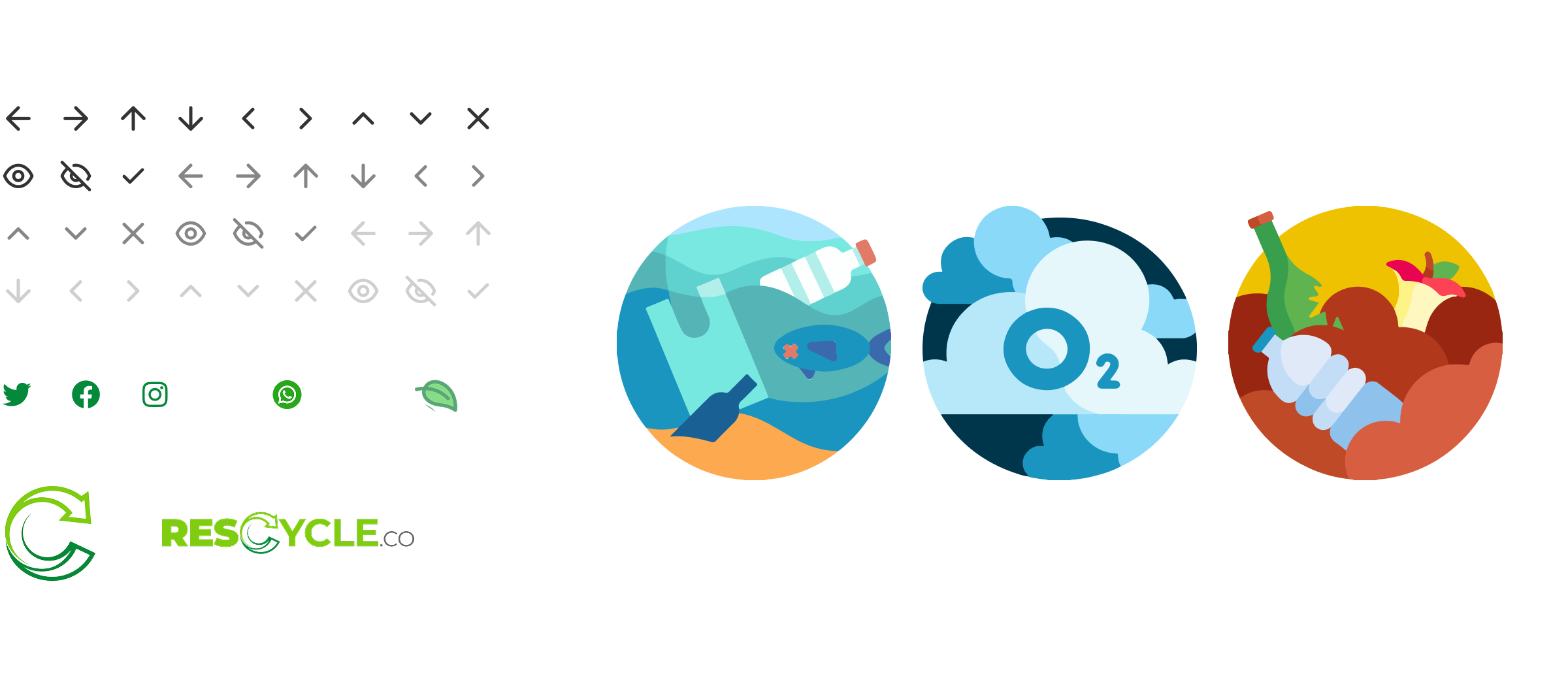
Icons & Illustrations
palm-icons.png
Results — Final Design
Final prototype — Landing page and Upcyclers Community in action
−25% bounce rate · +15% retention
A redesign that turned waste into opportunity — and visitors into community.